Yellowstone is a strange park to plan a trip to. It's 3,500 square miles, bigger than Rhode Island and Delaware combined, and the major sights are strung along the Grand Loop, a 142-mile figure-eight road that takes about five hours to drive in the summer without stopping. Which, of course, you will. Constantly. The entrances and a few of the best stops, like the Lamar Valley and Cooke City, hang off the loop as spur roads.
Five days is the sweet spot. Three feels rushed and you'll end up skipping things you'll regret. Seven gives you the breathing room to add a side trip into the Tetons, drive the Beartooth Highway, or spend a full morning watching for wolves in Lamar. But if you have one week of vacation and want to see the best of Yellowstone, the geysers, the canyons, the wildlife, and the lake, five days is what works. This itinerary is built for peak summer conditions; shoulder-season timing and crowds will vary, and winter is a completely different trip.
This itinerary is built around two ideas. First: drive the Grand Loop in one direction so you're rarely doubling back, the one real exception being the out-and-back into Lamar Valley, which is worth it. Second: do the famous, crowded stops early, at sunrise or just after, and the quieter, more reflective stops in the afternoon when the parking lots are full anyway.
At a Glance
The plan.
Fly into Bozeman, drive south through Gardiner, and enter the park at the North Entrance. Spend your first night near Mammoth Hot Springs. Move clockwise around the loop: Lamar Valley for wildlife, Canyon Village and Hayden Valley for the falls and the lake, Old Faithful for the geysers, looping back north through Norris and Mammoth to exit the way you came in, through the North Entrance, on your last day. You'll see every major basin, every major valley, and you'll get one full sunrise and one full sunset somewhere quiet.
Mammoth & the Northern Range
Pick up your car at Bozeman Yellowstone International (BZN) and drive the 90 minutes south on US-89. Stop in Gardiner for lunch, grab a burger at the Wonderland Café, or check out one of the food trucks, before continuing into the park. Enter through the historic Roosevelt Arch; budget fifteen minutes for the photo and the gate line.
Spend the afternoon at the Mammoth Hot Springs terraces. They are unlike anywhere else in the park, bone-white travertine, stair-stepping down a hillside, with active and dormant terraces wrapping a one-mile boardwalk loop. Do the lower terrace first (Liberty Cap, Palette Spring), then drive the upper terrace loop. Mammoth is one of the few places in the park where the wildlife comes to you. Don't be surprised if you're waiting on a dinner table while an elk herd works its way through the parking lot at dusk. That's a good reason to be back in the village by 7 PM.
Scope rental tip: If you want a spotting scope for Day 2's wolf-watching in Lamar Valley, arrange the rental today, since the Mammoth area is your best chance before the 4:45 AM departure tomorrow. Yellowstone Forever's field institutes and some Gardiner outfitters offer rentals; calling ahead is wise. While you're at it, grab a thermos and some grab-and-go breakfast food, there's a long, cold stretch tomorrow morning before the first real meal.
Before dinner, find the Yellowstone Mail Carrier's Cabin next to the Mammoth clinic. This small log structure was a waystation for the hardy souls who skied the park's snowbound roads each winter to deliver mail before motorized transport arrived. It takes less than ten minutes but earns you a story that most visitors completely miss.
- 10:30 AMBZN airport, pick up rental car90 min
- 12:30 PMGardiner, MT, lunch, last grocery stop before the park75 min
- 2:00 PMRoosevelt Arch & North Entrance15-30 min
- 2:30 PMMammoth Hot Springs, lower & upper terrace loops2 hrs
- 5:00 PMCheck into Mammoth Hot Springs Hotel or your Gardiner lodging15 min
- 5:15 PMWalk through historic Fort Yellowstone and the visitor center30 min
- 6:00 PMYellowstone Mail Carrier's Cabin, next to the Mammoth clinic10 min
- 7:00 PMDinner at the Mammoth Dining Room or restaurants in Gardiner90 min
Lamar Valley & the Drive to Cooke City
Set an alarm for 4:15 AM and be rolling by 4:45 AM. It hurts, but Lamar Valley is a different place before sunrise. The wolves are still active, the bison are on the move, and the parking pull-outs are empty enough that you can actually see what you came to see. Drive the northeast road past Tower Junction toward Lamar.
Look for the first big pull-out east of Slough Creek. It's one of the most reliable wolf-watching spots in the valley. Bring binoculars, a spotting scope if you have one, and look for clusters of other cars and people with tripods. If you see an empty pull-out with three spotting scopes all pointed at the same hillside, stop. The people behind those scopes know something you don't.
Today, keep driving past the valley instead of turning back. The Northeast Entrance Road from Lamar to Cooke City, MT is the stretch most people skip, which is exactly why I like it: fewer cars, fewer crowds, and the terrain shifts from open sage flats to dense lodgepole forest to high alpine meadow. Watch for pronghorn lower in Lamar, then keep an eye on the willow flats around Round Prairie and Soda Butte Creek for moose. Icebox Canyon, where the road squeezes between the creek and volcanic breccia walls, is worth slowing down for even without wildlife. Grab a late breakfast in Cooke City or neighboring Silver Gate, scruffy old mining towns just past the park's northeast corner, and leave time to browse the shops before turning back.
On the drive back west, stop for a picnic lunch at Slough Creek; it's right along the way before you reach Tower Junction. From there, make the short detour south to the Tower Fall overlook, then double back and take the spur road north to the Petrified Tree on your way toward Mammoth. They're in opposite directions from Tower Junction so plan a few extra minutes.
Spend the afternoon at a relaxed pace around Tower-Roosevelt, then have an early dinner at the Roosevelt Lodge Dining Room when it opens at 4:30 PM. It's the most relaxed dining room in the park, hearty Old West fare, and eating early sets you up for an optional golden-hour loop back through Lamar Valley while the light is best and the animals are moving again.
- 5:30 AMDawn drive into Lamar Valley, scan the pull-outs2 hrs
- 7:30 AMContinue east: Soda Butte Creek & Icebox Canyon60 min
- 8:30 AMRound Prairie pull-out, scan for moose30 min
- 9:30 AMArrive Cooke City & Silver Gate, coffee, late breakfast & browse the shops90 min
- 11:00 AMDrive back west, picnic lunch at Slough Creek along the way75 min
- 12:15 PMTower Fall overlook30 min
- 1:00 PMPetrified Tree, spur road off the Mammoth road20 min
- 1:30 PMDown time at Roosevelt before the evening drive3 hrs
- 4:30 PMEarly dinner at the Roosevelt Lodge Dining Room75 min
- 5:45 PMOptional: golden-hour drive back through Lamar Valley, second wildlife pass, only if you still have daylight and energy90 min
Grand Canyon of the Yellowstone & Yellowstone Lake
Drive south on the Dunraven Pass road. It climbs to 8,859 ft with views of the Absaroka Range; in early summer there are often grizzlies grazing on the slopes. Pull over at Mount Washburn trailhead, even if you're not hiking the summit, the view from the lot is worth the stop.
The Grand Canyon of the Yellowstone is a half-day all on its own. Do the North Rim drive first: Inspiration Point, Grand View, Lookout Point. Then drive across to the South Rim and walk to Artist Point, the classic view of the Lower Falls thundering into the canyon, with the yellow-and-rose walls on either side. I've been there more times than I can count, and I still stop.
Trade-off: fitting Canyon and the Lake into one day means cutting the steep hike down to the Brink of the Lower Falls. The rim overlooks above already give you a great view of the falls without the 600-foot switchback, so you're not missing the falls, just the close-up. If you have a sixth day to spare, it's worth adding back.
From Canyon, drive south through Hayden Valley, the southern echo of Lamar: broad, marshy, full of bison. Lamar was your better bet for wolves; Hayden is generally better for bison, grizzlies, and whatever happens to be standing in the road that morning. Drive it slowly. A single bison in the lane can cost you 30 to 60 minutes, so build that into your timing. Stop at Mud Volcano and the Sulphur Caldron, odd and sulfur-reeking thermal features most people blow right past. Don't. Then continue to Fishing Bridge and the north shore of Yellowstone Lake, the largest high-elevation lake in North America at over 7,700 ft.
Check in at the Lake Yellowstone Hotel. Even if you're not staying there, walk through the sun room. It's the prettiest building in the park and nobody will stop you from wandering in to look. Spend the rest of the afternoon relaxing lakeside before dinner.
- 6:45 AMBreakfast at the Mammoth Dining Room before checkout45 min
- 7:30 AMLeave Mammoth, drive Dunraven Pass90 min
- 9:00 AMNorth Rim drive, three overlooks2 hrs
- 11:00 AMLunch at Canyon Village dining hall45 min
- 11:45 AMArtist Point & the South Rim trail75 min
- 1:00 PMDrive south through Hayden Valley60 min
- 2:00 PMMud Volcano & Sulphur Caldron45 min
- 2:45 PMFishing Bridge & Pelican Creek45 min
- 3:30 PMCheck in at Lake Yellowstone Hotel, walk the sun room45 min
- 4:30 PMRelax lakeside before dinneropen-ended
- 7:00 PMDinner at the Lake Yellowstone Hotel90 min
Want this itinerary in your pocket?
Sign up for early access and we'll send you updates as the app comes together, plus new trip guides.
Old Faithful & the Geyser Basins
Start early from the Lake Hotel and make the geyser day easy on yourself. Break the drive at West Thumb Geyser Basin, where the hot springs steam right at the lake's edge. Then get to Old Faithful by 8:30 AM. Check the predicted eruption time at the visitor center, then start the Upper Geyser Basin boardwalk, Castle, Grand, Riverside, and Morning Glory. The full loop is about 4 miles and it's the densest collection of active geysers in the world.
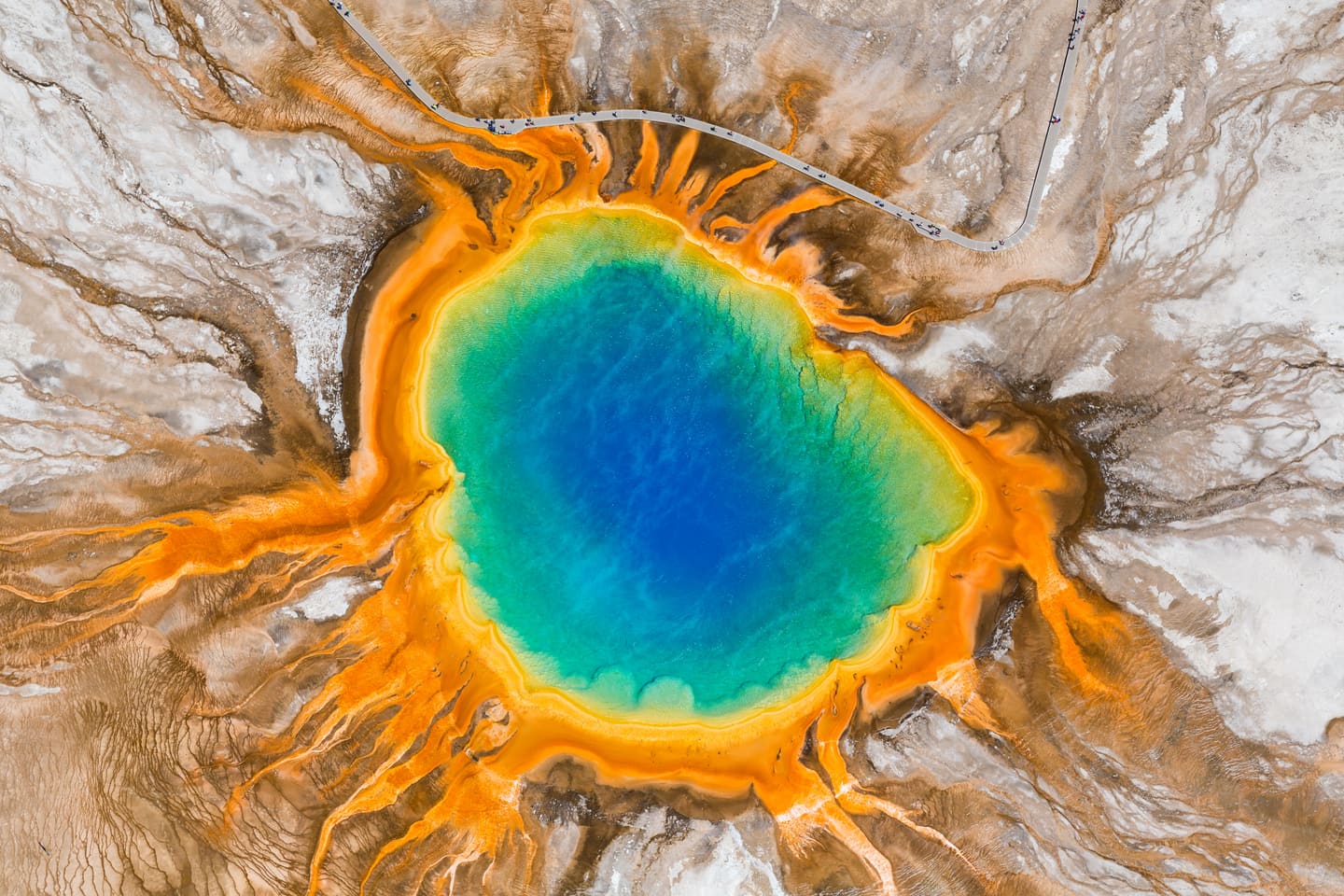
Make sure you're back at Old Faithful for the eruption. Then drive ten minutes north toward Midway Geyser Basin for Grand Prismatic, but know what you're choosing: at 2:30 PM in July, the Midway boardwalk lot can turn into a 20-minute wait for a space. For the famous overhead view, use the Fairy Falls trailhead and hike the roughly 1.5-mile round trip to the overlook above the spring. I've routed you here in the afternoon on purpose: if you ever come back and visit first thing in the morning, don't panic when the spring is steaming hard and looks washed-out from the boardwalk. That's normal. The overlook is the view you're actually here for, and the steam usually thins out by midday.
Head back to Old Faithful for the evening rather than rushing off. The Inn itself, built in 1904 entirely from local logs and stone, is worth slowing down for: walk the four-story log lobby, climb to the balcony if it's open, and find a chair on the porch facing the geyser. You're sleeping here tonight, so there's no reason to treat it as a drive-through.
- 6:30 AMGrab-and-go breakfast at the Lake Hotel Deli before checkout30 min
- 7:00 AMLeave Lake Yellowstone Hotel, West Thumb Geyser Basin en route90 min
- 8:30 AMArrive Old Faithful, check predicted eruption15 min
- 9:00 AMUpper Geyser Basin boardwalk loop2.5 hrs
- ~11:30 AMBack at the cone for the predicted eruption30 min
- 12:30 PMLunch at the Old Faithful Inn dining room75 min
- 2:30 PMGrand Prismatic + Fairy Falls overlook hike90 min
- 4:30 PMCheck into Old Faithful Inn, explore the lobby & balcony45 min
- 6:30 PMDinner & one more eruption from the Inn's porchopen-ended
Norris, Mammoth & the Drive Out
Leave Old Faithful and drive north to the Norris Geyser Basin, the hottest and most acidic in the park, with a totally different character from anywhere you've been the last two days. Walk the Porcelain Basin and Back Basin loops before the midday crowds build.
From Norris, continue north through Mammoth. Don't rush this leg: elk and bison turn up in the road here as often as in Lamar. Then head out the North Entrance through Gardiner. Do not push on to Bozeman after dark: the stretch of US-89 between Gardiner and Bozeman is heavily trafficked by elk and deer at night and the collisions are common. Leave Norris by mid-morning and you'll reach Bozeman with daylight to spare; if your flight is the next morning, an overnight in Gardiner works just as well and shortens the drive.
- 7:30 AMBreakfast at the Old Faithful Inn dining room before checkout60 min
- 8:30 AMDepart Old Faithful Inn for Norris45 min
- 9:15 AMNorris Geyser Basin, Porcelain & Back Basin loops90 min
- 11:00 AMDrive north through Mammoth75 min
- 12:30 PMLunch in Gardiner60 min
- 1:30 PMNorth Entrance, drive to Bozeman90 min
- 3:00 PMArrive Bozeman, dinner or catch your flightopen-ended
What to know before you go
Book lodging a year out
In-park rooms, especially Old Faithful Inn and the Lake Hotel, open for reservations 13 months in advance and fill within days for summer.
Carry bear spray
Even on short walks. Park stores sell canisters; rentals are usually available for about $10 a day through Bear Aware/TrailQuipt at Canyon or Old Faithful, and outside the park in Gardiner and West Yellowstone.
Cell service is rare
Mammoth, Old Faithful, and Canyon have spotty signal; everywhere else is dead. Download offline maps before you go, and consider a GPS-triggered audio driving tour like GuideAlong. It works without a signal.
Layer up
Even in July, mornings in Lamar Valley can be in the 30s°F. By noon you'll be in a t-shirt. Bring layers you can shed.
Stay on the boardwalks
Thermal features sit on a thin crust over boiling water. People have died here by stepping off the path, and burn injuries happen every year. Don't.
Watch the wildlife rules
Stay 100 yards from bears and wolves, 25 yards from everything else. Bison cause more injuries here than any other animal. They're fast.
Budget a bison buffer
Add 30 minutes to every drive. A single bison standing in the road can turn a 20-minute stretch into 50, and it happens daily on the Lamar and Hayden roads.
Pack a cooler
Lodge dining halls can mean a 1–2 hour wait for lunch in peak season. A cooler with sandwiches and snacks buys back that time for hiking and wildlife.
Download the NPS app
Get the NPS app and download Yellowstone's offline maps before you go. Cell service inside the park is almost nonexistent.
Book dining ahead too
Many in-park dining rooms, including Old Faithful Inn and Lake Hotel, now require or strongly recommend reservations, even for breakfast. Book when you book your room.
Arrange scope rentals at Mammoth
If you want a spotting scope for Lamar Valley wolf-watching, rent it on Day 1 in Mammoth or Gardiner, before the 4:45 AM departure on Day 2.
Download the Wildlife Scouts app
Kids can log every animal they spot with the Yellowstone Wildlife Scouts app, a fun way to keep younger travelers engaged all trip long.
Where to stay
If you can get reservations, sleep in the park. The driving math alone is worth it, staying in West Yellowstone means an extra 60–90 minutes a day getting into and out of the park. Old Faithful Inn is the crown jewel and the only place you should actively try for; everywhere else is a means to an end. If the Inn is booked solid, the Old Faithful Snow Lodge is a short walk away, more modern, and usually easier to get.
If in-park lodging is full, the best gateway towns are Gardiner (North Entrance, closest to Mammoth and Lamar) and West Yellowstone (West Entrance, closest to Old Faithful). Cody is beautiful and has the Buffalo Bill Center, but it adds an hour of driving each way. Avoid Jackson unless you're combining the trip with the Tetons. It's a long, switchback-heavy drive from the South Entrance, though if you are doing both parks, flying into Jackson Hole (JAC) and running this loop in reverse is the smarter play.
Traveling with young kids or grandparents? This pace can run long for some groups, so build in extra downtime between stops and don't be afraid to cut a stop short if the group is fading.
One last thing
The hardest part of planning a Yellowstone trip isn't logistics, it's making peace with the fact that you can't see everything. Even in five days, you'll miss things. The Bechler region, the Lone Star Geyser hike, the back side of the Mirror Plateau, the entire eastern Beartooth corridor. That's fine. Yellowstone isn't a place you finish.
The point of the itinerary above isn't to optimize every minute. It's to give you a defensible spine for the trip so you're not standing in the parking lot at 9 AM wondering whether to go left or right. Yellowstone rewards flexibility more than planning. Some of the best sightings happen when you throw out the day's schedule and follow a line of parked cars. Use it as the starting point, not the script.