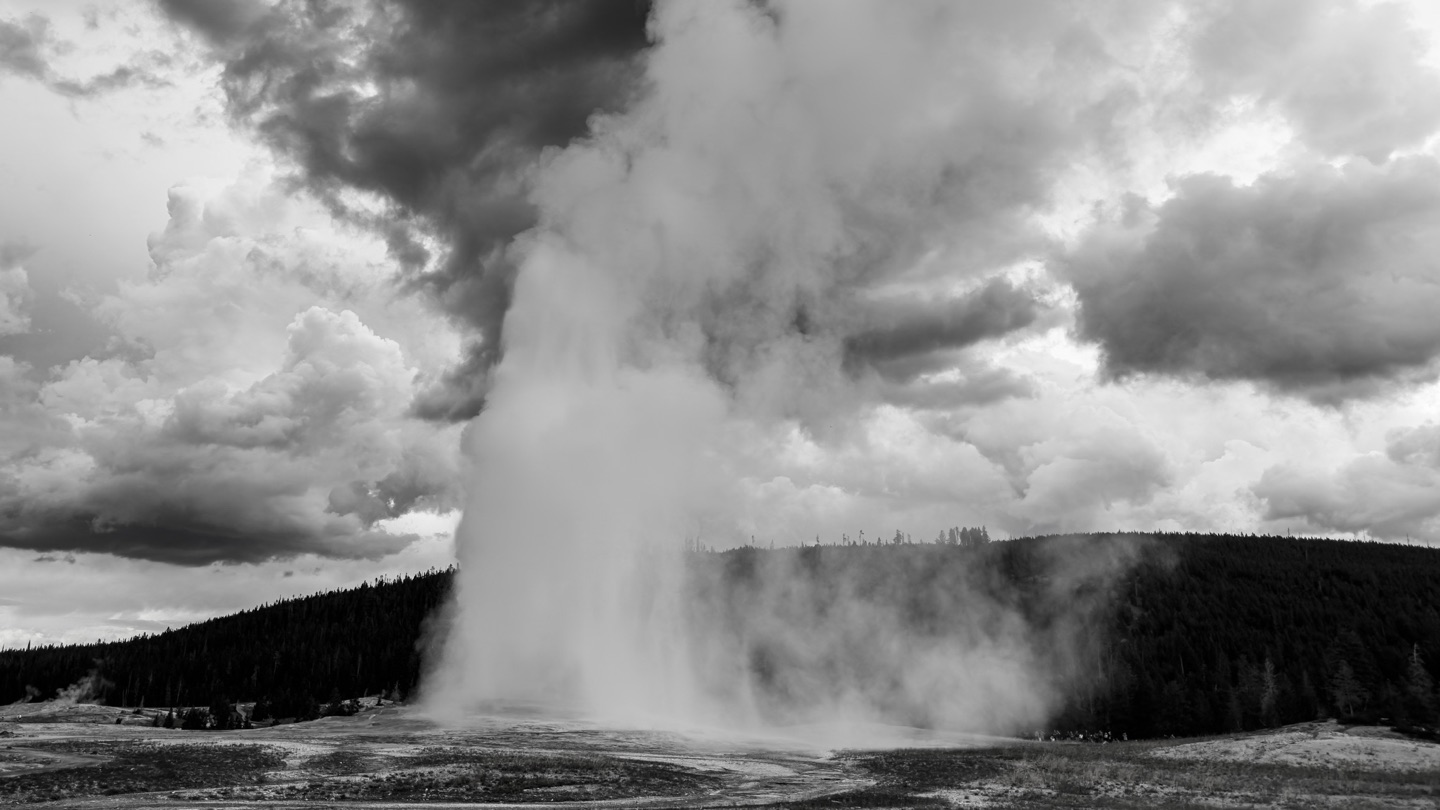
The short version: the National Park Service lists a median interval of 102 minutes, plus or minus 10 minutes, as of January 2025. Observed intervals have ranged from 54 to 118 minutes. See the current NPS geyser data before you leave. The more useful version is that the only number worth planning around is the current prediction, when one is available. That prediction is an estimate based on what the geyser just did. It is useful for itinerary planning, but it is not a dinner reservation, a train schedule, or a binding agreement with hydrothermal water under Wyoming.
If this is your first Yellowstone trip, build your Old Faithful stop around the current prediction, then leave room for conditions that can change during the day. Parking, walking distance, thunderstorms, and wildlife traffic can all affect the schedule. Check the current NPS conditions before you leave. Plan to reach the viewing area 30-45 minutes early, and keep the rest of the day flexible. Sometimes the elk is 300 yards away. Traffic will stop anyway.
At a Glance
How Old Faithful is predicted
Old Faithful is one of the few major Yellowstone geysers that can be predicted with useful regularity. The basic idea is simple: observers time the length of the previous eruption, then use that duration to estimate the interval before the next one. A shorter eruption is usually followed by a shorter wait. A longer eruption usually means a longer wait. This is a useful pattern, not a promise about the exact next time. The resulting estimate is a practical interpretation of recent behavior, not a mechanical appointment kept by the geyser.
That does not make the prediction exact. The National Park Service notes that Old Faithful's interval changes over time, and its average wait has lengthened over the decades as Yellowstone's hydrothermal plumbing shifts with earthquakes and other changes underground. A prediction is a trained estimate for the next eruption, not for every eruption later in your vacation. Treat the interval as probabilistic information: helpful for decisions, but always subject to geological variation and changing conditions.
The prediction also has a human element. Observers record each eruption, interpret its duration, and communicate a forecast to visitors. That process explains why a posted time can change after a new observation. Build your schedule around that uncertainty instead of treating a forecast as an appointment.
This distinction is especially important when your itinerary includes several geographically separated destinations and limited daylight.
This matters because a stale prediction can be worse than no prediction. If you checked a website at breakfast in West Yellowstone, then wandered Madison, Firehole Canyon, and Biscuit Basin before driving to Old Faithful, check again. The geyser may have erupted while you were looking at something else. Yellowstone is full of distractions. Some of them are boiling.
Plan on a window, not a minute. Arrive at the viewing area at least 30-45 minutes before the predicted eruption. That is a planning recommendation, not a park rule. Add more time whenever current NPS conditions suggest delays in parking, walking, or weather.
Where to check the prediction
Use current resources, and confirm each one is live and clearly showing today's information. A prediction from yesterday is a souvenir, not a plan. The NPS notes that predictions may be unavailable while the Old Faithful Visitor Education Center is closed. The last prediction can remain posted until a new one is available, so check nps.gov or the NPS App for current availability.
- NPS geyser predictions. The official table for Old Faithful and several other predictable geysers. If it loads slowly or looks stale, cross-check with the park app or in-person boards once you arrive.
- NPS Old Faithful area page. Explains where to watch and where predictions are posted. A useful reality check before you build a whole day around one eruption.
- GeyserTimes. A respected community resource for geyser observations and predictions. Treat it as a strong planning aid, then verify the specific prediction you are using is current.
- Yellowstone current conditions. Not a prediction page, but road closures, weather, and construction can decide whether your timed plan survives contact with the real park.
Building a Yellowstone day around Old Faithful?
Join the early access list for practical Yellowstone planning updates and the trip-planner app as it comes together.
Peak-season parking and crowd tips
Old Faithful is one of the easiest Yellowstone landmarks to visit and one of the easiest places to underestimate. The complex has a visitor center, lodges, restrooms, dining, and parking areas. Give yourself extra time for parking, walking, and weather. Conditions vary by date, so defer current access and traffic information to the NPS conditions page. For mobility needs, see our guide to mobility scooters and wheelchair access before you choose a viewing spot. Our guide to late-August crowds covers the busiest summer tradeoffs.
Arrive early or late
My practical preference is to try morning or early evening when your schedule allows. This is not a guarantee about crowd levels. Check the current NPS conditions, then choose the time that gives you the most flexibility.
Do not cut the buffer
Thirty minutes can disappear into parking, bathrooms, snacks, and walking from the far end of the lot.
Use the visitor center
Recheck the posted time, ask a ranger if available, and adjust before you choose a bench.
Keep weather gear handy
A thunderstorm or cold wind can make a 40-minute wait feel longer. This is still the mountains.
If your day is flexible, pair Old Faithful with the Upper Geyser Basin boardwalks rather than treating it as a quick in-and-out stop; it slots neatly into a full Yellowstone itinerary if you are still mapping your days. If the geyser has just erupted when you arrive, you can walk toward Geyser Hill, check other features, and come back for the next window. If you are on a tight schedule, give yourself permission to watch from the main viewing area, skip the deeper basin walk, and move on. Yellowstone does not reward pretending every stop can be comprehensive.
A sample visit timeline
Say the current prediction shows Old Faithful at 2:20 PM, plus or minus about 10 minutes. A reasonable peak-season plan looks like this:
- 1:00 PM: Leave the previous stop if you are within the central-western park corridor. Leave earlier if you are coming from Canyon, Lake, West Thumb, or a gateway town.
- 1:25 PM: Reach the Old Faithful area, assuming no major delays. Park wherever the lot gives you a practical opening.
- 1:35 PM: Stop at the visitor center or a posted board and recheck the prediction.
- 1:45 PM: Be at the viewing area. Pick a spot. Put layers, water, and patience within reach.
- 2:10-2:30 PM: Watch for the eruption window, but do not panic if the geyser takes a little extra time.
- Afterward: Let the crowd thin before rushing back to the car, or walk part of the Upper Geyser Basin if weather and energy allow.
Coming from West Yellowstone? Add entrance-station time and the drive from Madison Junction. Coming from Grand Teton through the South Entrance? Add a lot more. The map may make Yellowstone look compact. The map is being polite.
Short checklist
- Check the latest Old Faithful prediction shortly before leaving.
- Confirm the website or app is current and operational.
- Build in road, wildlife, weather, and parking delays.
- Arrive at the viewing area 30-45 minutes before the predicted eruption.
- Allow extra time when current NPS conditions point to delays or when your plan has little flexibility.
- Recheck the prediction after you arrive at Old Faithful.
- Bring layers, water, sun protection, and patience.
- Stay on boardwalks and keep children close near thermal areas.
Common questions
How often does Old Faithful erupt?
The NPS geyser page lists a median interval of 102 minutes, plus or minus 10 minutes, as of January 2025. Observed intervals have ranged from 54 to 118 minutes. Use the current prediction when it is available.
How accurate is the Old Faithful eruption prediction?
Predictions are usually given as a target time plus or minus about 10 minutes. They are a trained estimate based on the length of the previous eruption, not a guaranteed clock time, so plan to arrive 30 to 45 minutes early.
How long does an Old Faithful eruption last?
An eruption usually lasts between about 1.5 and 5 minutes and sends thousands of gallons of boiling water skyward, according to the National Park Service Old Faithful page. A longer eruption generally means a longer wait until the next one.
How early should I arrive to see Old Faithful erupt?
Plan to be at the viewing area 30 to 45 minutes before the predicted time. In July, August, and on holiday weekends, add more buffer for parking, the walk from the lot, and crowds. See our guide to Yellowstone in late August for a closer look at that peak-season tradeoff.
One last safety reminder
All that infrastructure can make the area feel tame. It is not. Obey posted closures. Stay on boardwalks and never step onto, or approach, the fragile crust around a thermal feature. Keep hands and feet out of thermal runoff, and give wildlife room even near the developed areas. Follow current NPS wildlife-safety guidance: stay at least 100 yards from bears, wolves, and cougars, and at least 25 yards from other wildlife. The ground can be thin and the water deadly hot, so never let the chase for a prediction time make you careless. Get there early, recheck the time, settle in, and let the geyser be a geyser.