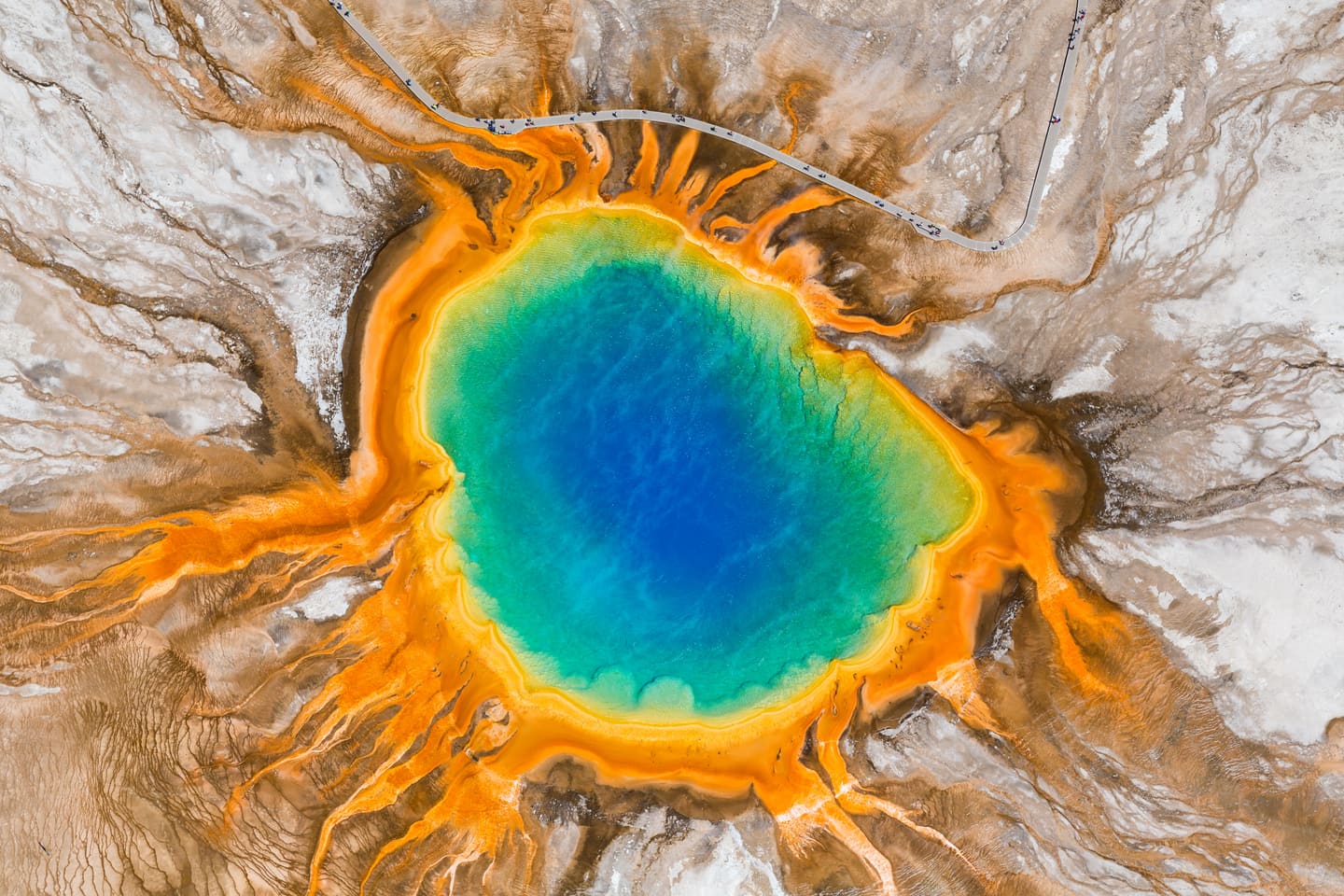
Most of what makes Yellowstone famous, the geysers, the hot springs, the canyon overlooks, sits right next to a road, on a boardwalk or a paved path. That surprises a lot of people who use a mobility scooter or wheelchair, because the park's reputation is built on hiking and backcountry photos. In practice you'll spend more time on boardwalk than backcountry. That doesn't make the whole park easy to get around, though, and the gap between the two is what this guide is about.
The short answer
Yellowstone is more accessible than most visitors assume. Old Faithful, Grand Prismatic, West Thumb, the lower terraces at Mammoth, these are all reachable on boardwalks or paved paths without setting foot on a dirt trail. That's the good news, and it's real.
The caveat: there is no single map or rating system that guarantees a smooth, gap-free, level surface everywhere in the park. Boardwalk widths vary. Some sections are wooden slats with visible gaps between boards. Some buckle or heave a little from frost over the winter and haven't been resurfaced yet. Grades creep up in places you wouldn't expect from a map. At midday, passing another wheelchair or a stroller on a narrow boardwalk can be its own small ordeal. None of this is disqualifying. It's worth knowing before you build an itinerary around it.
Conditions also shift seasonally. Boardwalks get repaired and occasionally rerouted; shoulder-season snow or mud can affect approaches to a site even when the boardwalk itself is fine. If you're considering a fall visit, our guide to Yellowstone in October covers how shoulder-season weather can change footing and access at these same sites. The single best thing you can do before a trip is call the specific visitor center for the area you're headed to, or check nps.gov/yell/planyourvisit/accessibility.htm for current conditions, rather than relying on any blog post, including this one, for the day-of ground truth. That page lists which features have accessible parking and surfaces, basin by basin, and it's kept current in a way no outside write-up can match.
If you're traveling with someone who doesn't use a mobility device but also isn't interested in hiking, our guide to Yellowstone for non-hikers covers a broader no-hiking itinerary. This post stays narrowly focused on mobility device logistics.
The NPS Access Pass
If you're a U.S. citizen or permanent resident with a permanent disability, the National Park Service offers a free, lifetime Access Pass (the disability version of the America the Beautiful pass) that covers entrance fees at Yellowstone and every other federal recreation site that charges one. A lot of people who qualify have never heard of it.
Eligibility and documentation requirements are set by the NPS, and they're specific, so I'll point you to the source rather than paraphrase. Check nps.gov/planyourvisit/passes.htm for current eligibility rules and what documentation to bring. In short, you'll need proof of a permanent disability, a doctor's statement or a document from a federal or state agency such as the VA or Social Security. You can get the pass free in person at any entrance station or visitor center, or order it online for a small processing fee. Sort it out before you reach the gate, it'll save you a conversation while a line of cars waits behind you.
Renting scooters and wheelchairs in or near the park
The one thing the park does offer is manual wheelchairs. The major visitor centers, Old Faithful, Canyon, Albright at Mammoth, Grant Village, Fishing Bridge, and Norris, along with the park lodges, lend standard manual wheelchairs at no charge, and the medical clinics rent them on a first-come, first-served basis. Confirm current availability with the visitor center or clinic before you count on one for a specific day.
Electric scooters are a different matter. There's no rental kiosk inside Yellowstone where you can pick up a powered scooter for the day. The park is enormous and spread across five entrances, and there isn't on-site scooter rental deep inside it.
For a scooter, you rent in a gateway or hub town, West Yellowstone, Bozeman, Jackson, Cody, or Billings, where medical-supply outfitters rent powered scooters and chairs, often with delivery and pickup. Availability is limited, especially in peak summer, so this isn't something to figure out on arrival. Book ahead, and call the outfitter directly to confirm they have what you need in stock for your dates rather than assuming walk-up availability. I'm not naming specific companies or prices here, since both change; a search for "mobility equipment rental" plus the town you're flying into or driving through will turn up current options.
Boardwalk-by-boardwalk accessibility notes
This is the part that matters most for planning. Below is my read on the major thermal basins, anchored to what's observable about grade, surface, and layout and to what most visitors report. Conditions change, so treat it as a starting point for your own research and a call to the visitor center, not a guarantee.
Old Faithful & Upper Geyser Basin
Most accessiblePaved walkways run from every parking area to Old Faithful itself, and on to the other features near the visitor center. The surface is largely flat, wide, and a mix of pavement and boardwalk, consistently one of the most manageable major sites in the park for mobility devices. You can get a clear view of the eruption without leaving the paved area, and the visitor center has accessible restrooms.
Midway Geyser Basin (Grand Prismatic)
Mostly accessible, one caveatThe boardwalk loop directly at the spring is flat and generally manageable. It gets you right up next to Grand Prismatic and the other pools in the basin, a good experience at ground level. Note that the boardwalk crosses the Firehole River on a bridge, and the lot here fills early in summer.
The famous overhead photo, the one you've seen everywhere, comes from the Grand Prismatic overlook off the Fairy Falls trailhead, a separate there-and-back of more than a mile with an uphill grade on gravel and dirt. That trail is not realistic for most mobility devices. The at-grade boardwalk view is the practical option here, and it's still one of the best things in the park, just don't plan on the overlook photo.
Mammoth Hot Springs
MixedMammoth is the most uneven of the major sites, so read this one carefully. On the lower terraces, parts of the boardwalk are accessible, the top of Palette Spring and the top of Canary Springs can be reached by wheelchair when there's no snow, and accessible parking sits near Liberty Cap. But the transitions from the asphalt walkways onto the boardwalks can need a push, and the rest of the area runs to stairs and steep grades. The upper terrace loop has the most stairs and steepest sections and isn't realistic for most wheelchairs or scooters.
If the upper terraces are on your list, the better bet is the one-way Upper Terrace Drive. It has an accessible parking area near the start, and a short boardwalk leads from accessible parking to an exhibit at Orange Spring Mound. You also get viewpoints from the car along the loop without needing the boardwalk itself.
West Thumb Geyser Basin
Most accessibleA boardwalk loop directly on the shore of Yellowstone Lake, with accessible parking at the trailhead. There's a shorter inner loop and a longer outer loop. The inner loop is the more level option; the lower lakeside section of the outer loop drops toward the waterline, and NPS notes grades of up to about 10% there, steeper than a standard accessible ramp, so a wheelchair user may want assistance on that stretch. This is still one of the more manageable basins in the park, scenic, with thermal pools bubbling up right at the shore, but walk the lower section first before you commit to the full outer loop.
Norris Geyser Basin
MixedThe Porcelain Basin loop is the shorter of the two, but it still drops down into the basin on ramped boardwalk and includes grades and steps in places, so check current conditions and plan on possibly needing assistance. The Back Basin loop is considerably longer, has more elevation change, and includes stretches of uneven boardwalk. If you're choosing one, Porcelain is the more approachable, but Norris overall is one of the tougher basins for mobility devices, so treat it as conditional rather than a sure thing.
Two things worth keeping in mind across every basin: afternoon thunderstorms are common in summer and can make wooden boardwalks slippery, and midday crowds at the popular basins can make passing room on narrower boardwalk sections its own mobility challenge, independent of the terrain itself. Early morning or early evening visits tend to be easier on both counts.
Most accessible basins
Old Faithful / Upper Geyser Basin, Grand Prismatic's at-grade boardwalk loop, West Thumb Geyser Basin, Mammoth's lower terrace, Norris's Porcelain Basin loop.
Use caution
The Grand Prismatic overlook trail, Mammoth's upper terrace loop and its stairs, Norris's Back Basin loop, any boardwalk during a midday crowd surge or afternoon storm.
Plan an accessible Yellowstone trip with confidence
Sign up for early access and we'll send you updates as the app comes together, plus new trip guides like this one.
Driving and parking
Yellowstone has standard accessible parking spaces at every major visitor center and at most large pullouts, marked the same way you'd expect anywhere else. What the park does not have is an internal shuttle system. Everything inside Yellowstone is reached by personal or rental vehicle; there's no equivalent to the shuttle buses you might have used at Zion or Yosemite.
That makes your vehicle the most important piece of equipment on the trip, after the mobility device itself. If you don't already own a ramp van, a hitch-mount carrier, or another easy-loading setup, arrange one before you arrive. Trying to improvise scooter or wheelchair loading in a parking lot in West Yellowstone is a bad way to start a vacation.
Visitor centers and lodges
The major visitor centers, Old Faithful, Canyon, Albright (Mammoth), Grant Village, and Fishing Bridge, generally have accessible entrances and restrooms. The same goes for the park's historic lodges, but "historic" is the operative word: buildings like the Old Faithful Inn and the Lake Yellowstone Hotel have older wings that can have real accessibility limitations, elevators that don't reach every floor, rooms with steps, narrow hallways in the original construction.
If lodging accessibility matters for your trip, call the specific property directly and ask about your specific needs, room location, elevator access, bathroom layout, rather than assuming "accessible" on a website means what you need it to mean. This is true of older lodges anywhere, not a knock on Yellowstone specifically. If you're still mapping out where to base yourself, our 5-day Yellowstone itinerary can help you think through lodging and routing before you book.
Practical tips
Plan for power. If you use an electric scooter, bring spare batteries or a clear charging plan. Charging infrastructure inside the park isn't something to count on, outlets at lodges and visitor centers exist but aren't guaranteed to be available or convenient when you need them.
Call ahead before a long drive. Boardwalk conditions can change with repairs, weather, or seasonal closures. A two-minute call to the relevant visitor center before you drive 45 minutes to a site beats finding out about a closure when you arrive.
Consider an accessible-vehicle tour. Some operators in the gateway towns offer guided tours in accessible vehicles, which can be a good alternative to self-driving and self-loading a mobility device every day, especially for a shorter trip.
One last thing
Yellowstone won't be effortless if you use a mobility scooter or wheelchair. But the highlights you actually came for are more reachable than most people expect. Plan around the boardwalks that work, skip the ones that don't, and call ahead when you're not sure. That's most of the battle.