Late August is the question mark of the Yellowstone calendar. Too late to be early-summer quiet, too early to be true shoulder season, and nowhere near the free-for-all of the Fourth of July. If you're staring at a trip in the last two or three weeks of August and wondering whether you've missed the worst of it or walked straight into it, the honest answer is a little of both.
Here's what's actually true about that window, what changes week to week, and how to plan around the parts that don't change no matter when you go. If you're still mapping out the rest of the trip, our 5-day Yellowstone itinerary is a good starting point regardless of which month you land in.
Where late August sits in the season
Yellowstone's peak season runs roughly from Memorial Day through Labor Day, and late August is squarely inside it. That matters, because it's easy to hear "after the kids go back to school" and assume the park empties out the way it does in October. It doesn't, not right away.
What you get is a taper, not a cliff. Crowds stay heavy through about the third week of August, then thin in the final week and especially after Labor Day, once most school districts are back in session and family travelers drop out of the visitor pool. School start dates vary a lot by state and even by district, though, some start the first week of August, some wait until after Labor Day, so the exact week the crowds visibly drop shifts year to year. If you're booking a year out, the safest framing is this: late August is still peak, but with a visible taper, and the later in the month you go, the more of that taper you get.
What crowds actually look like
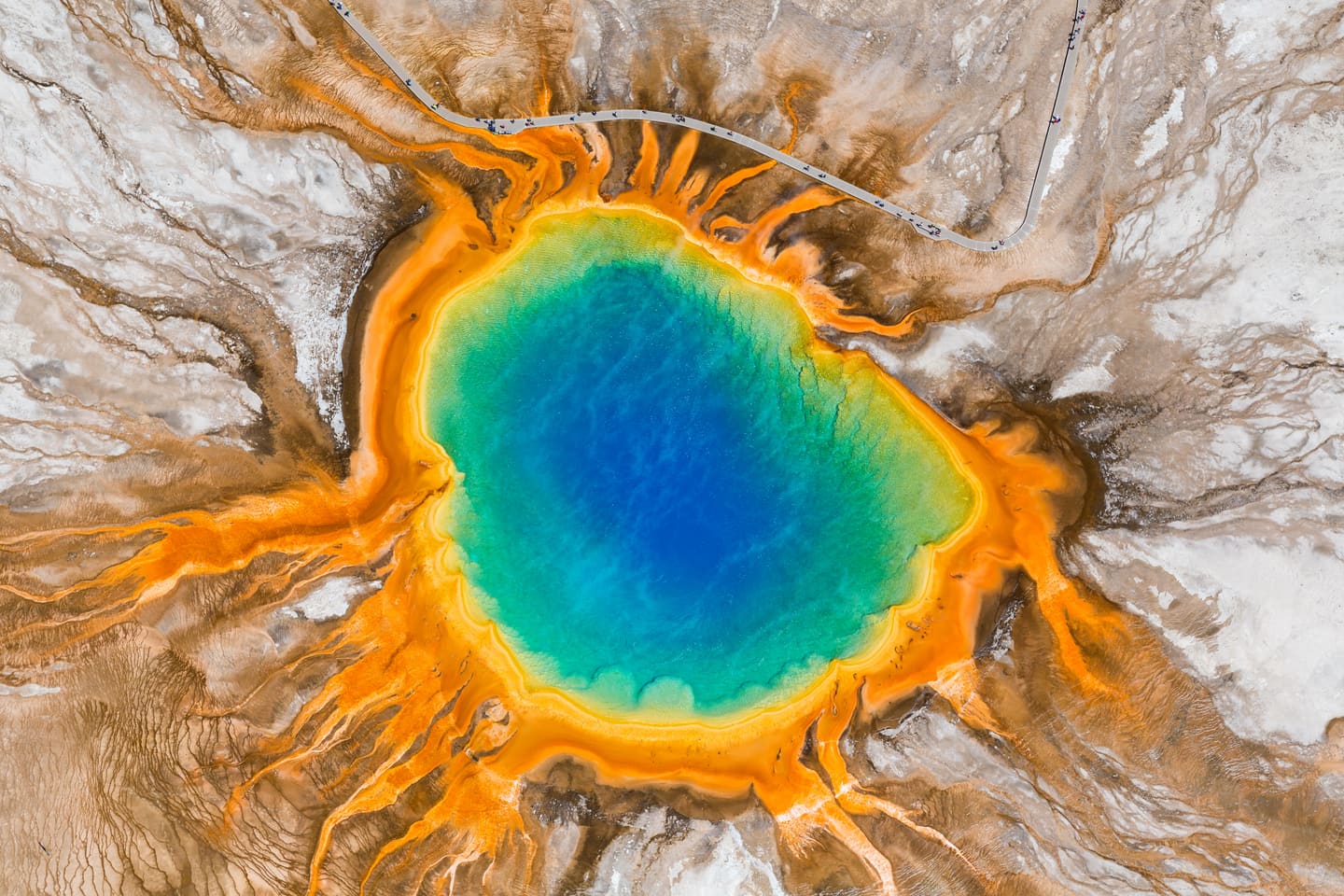
Walk into any major basin in late August between mid-morning and mid-afternoon and the parking lots will be full. Old Faithful, Midway Geyser Basin (Grand Prismatic), and Mammoth Hot Springs all see this daily, cars circling for spots, overflow lots opening, foot traffic backed up on the boardwalks. The eruption viewing area at Old Faithful is standing-room-only for predicted eruptions, especially the ones that fall in the early afternoon window when day-trippers are at their peak. That kind of crowding is exactly when boardwalk congestion is most likely to slow down anyone navigating the park's mobility scooter or wheelchair routes, so timing matters even more if accessibility is a factor.
Lamar Valley and Hayden Valley see more wildlife jams in late August, but that's about traffic volume, not more animals. A bison ambling across the road that would barely register in October can stop fifteen cars in late August, simply because there are more cars on the road to stop.
Lodging follows the same pattern. By the time late August arrives, in-park hotels and campgrounds have typically been booked solid for months, and same-day availability for in-park lodges is essentially nonexistent. Note that every campground inside the park now takes advance reservations in summer, so there's no first-come site to chase in late August (Mammoth only goes first-come from mid-October through spring). If you haven't booked yet and you're set on late August, your realistic options are gateway towns, watching for last-minute cancellations, or the first-come campgrounds on the surrounding national forest land outside the park.
Weather and conditions
Late August days in the valleys are typically warm and dry, often in the 70s to 80s°F, with cooler temperatures at elevation. Nights, though, have already started to turn. It's common for overnight lows to dip into the 30s and 40s°F, especially at higher elevations like Mammoth or anywhere near Dunraven Pass. Pack layers you can add at 6 AM and shed by noon.
Late August also falls within typical Western wildfire season, which means smoke and haze are a real possibility depending on regional fire activity that year. This varies enormously, some years the skies are clear the entire trip, other years smoke drifts in from fires hundreds of miles away and settles over the park for days. There's no way to predict it months in advance, so check nps.gov/yell for current air quality and fire alerts in the days before you leave, not when you booked.
Afternoon thunderstorms remain common in late August, the same as they are throughout midsummer. Plan outdoor activities for morning or early evening when you can, and carry a rain layer regardless.
Planning a late-August trip?
Sign up for early access and we'll send you timing-specific guides as the app comes together.
How to actually beat the crowds in late August
None of the above means a late-August trip has to feel crowded the whole time. It means you have to be intentional about when and where you show up.
The Core Strategy
Arrive at major basins by 7 or 8 AM, or plan to come back after 6 PM once the day-trippers from gateway towns have started heading out. Old Faithful, Midway, and Mammoth are different places in that early window. You can walk the boardwalks instead of shuffling through them.
Treat 11 AM to 3 PM as a dead zone for sightseeing. This is the worst window at essentially every major site in the park, and fighting it is a losing battle. Use those hours for driving between destinations, eating lunch, or doing a longer hike on a trail that doesn't draw the basin crowds, not for trying to see Grand Prismatic or catch an eruption.
Book any in-park lodging 11 to 13 months ahead. This is the same standard advice that applies to any peak-season Yellowstone trip, but it's worth repeating here because late August bookers sometimes assume the "back to school" effect means rooms loosen up. They don't, not by the time most people are actually booking.
Consider basing in a less-trafficked corridor. The Lamar Valley and Northeast Entrance area, anchored by Cooke City, sees noticeably lighter crowds than the Old Faithful and Grand Loop core, even in late August. If your priority is wildlife over geysers, you can build most of a trip around that corridor and skip the worst of the basin congestion entirely.
Arrive midweek if you can. Tuesday through Thursday arrivals tend to be lighter than the weekend turnover days, when one group of visitors is checking out and another is checking in on top of them.
Why some people specifically choose late August over July
Late August isn't only a compromise people settle for. Plenty of travelers choose it on purpose. Retirees and travelers without kids often shift their trips here once school is back in session and the family-travel surge has passed. Days are still long, with good light well into the evening. The early-summer wildflowers are gone, but fishing season is in full swing on the Madison, Firehole, and Yellowstone Rivers. And toward the very end of the month, some years, you'll catch the first elk bugles of the season. That sound builds through September, and it's one of the best reasons to be in the park in the fall.
Verdict
If you can't get away in September or October but you want lighter crowds than the middle of July, late August is a reasonable middle ground. If your dates are flexible, weigh it against visiting in October, which trades a few of late summer's warm afternoons for a much quieter park. Late August is not empty. The parking lots still fill, the boardwalks still have foot traffic, and you'll still want a plan rather than winging it. But build your days around the early-morning and evening windows, treat midday as travel time rather than sightseeing time, and you'll see a noticeably calmer park than the one most July visitors get.
Quick reference
Arrive before 8 AM
Major basins like Old Faithful, Midway, and Mammoth are dramatically calmer in the first couple hours after opening light.
Avoid the 11 AM–3 PM window
This is the worst stretch at every popular site in the park. Use it for driving or eating, not sightseeing.
Book lodging a year out
In-park rooms fill for late August the same way they do for July. Same-day availability is essentially nonexistent.
Check fire and smoke alerts
Late August falls within Western wildfire season. Check nps.gov/yell for current air quality before you go, not when you booked.
Pack for both ends of the thermometer
Expect 70s–80s°F by day and 30s–40s°F overnight at elevation. Layers aren't optional.
Try the Lamar / Northeast corridor
It runs noticeably lighter than the Old Faithful and Grand Loop core, even at the height of late-August traffic.