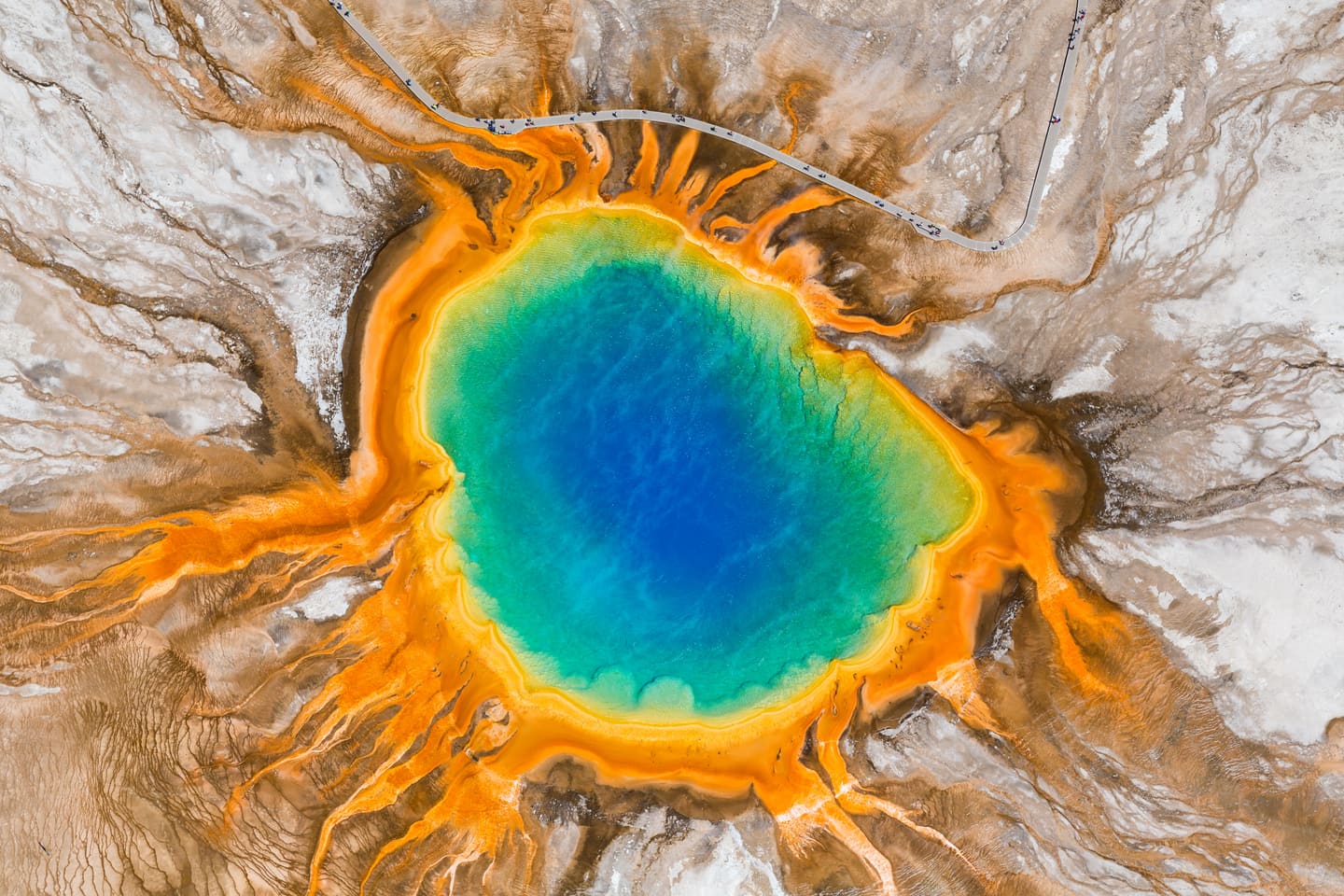
Somewhere along the way, Yellowstone got lumped in with parks like Zion and the Tetons, places where the good stuff is at the end of a trail and the parking lot view is just a teaser. That's not Yellowstone. Yellowstone is, structurally, a drive-and-boardwalk park. The geysers, the hot springs, the canyon, the wildlife, almost all of it sits within a few dozen yards of a parking lot, reachable on flat pavement or boardwalk. You don't need to be a hiker to see this park properly. You won't need big hikes, but you should still plan on short walks, boardwalk loops, patience in the parking lots, and the occasional set of stairs or graded path along the way.
That matters because a lot of people quietly assume otherwise and either skip Yellowstone or show up dreading a week of trails they can't or don't want to do. If you have mobility limits, you're traveling with older parents, you've got young kids who melt down after a quarter mile, or you simply don't like hiking, this is the post for you. Below I'll go through which of the big sights are boardwalk-only, which require a real uphill walk you can skip without missing much, and how to build a non-hiking trip that covers more ground per day than a hiking one does.
At a Glance
A viewing park, not a hiking one
The confusion is understandable. Yellowstone has over a thousand miles of backcountry trail, and the photos that circulate online, the aerial shot of Grand Prismatic, the long lens shot of a wolf in Lamar, can make it look like you need serious trail time to get anything worth seeing. In practice, the park's design works against that impression. Old Faithful, the main basin view of Grand Prismatic, the Mammoth Hot Springs terraces, Yellowstone Lake, the wildlife of Hayden and Lamar Valley, and the overlooks of the Grand Canyon of the Yellowstone are all reachable by paved boardwalk, short flat path, or a few steps from a roadside pullout. Zero hiking required.
This isn't an accident. Yellowstone's thermal features are dangerous to approach off-trail, the crust over boiling water is thin and people are injured or killed every year by stepping off the boardwalk, so the park has built extensive, well-maintained walkways directly to the best vantage points. The infrastructure that exists for safety reasons happens to make this one of the most physically accessible national parks in the country for its size.
The boardwalk basins
The thermal basins are the heart of a Yellowstone trip, and they're also the most boardwalk-friendly part of the park. Here's where each major basin stands.
Old Faithful and the Upper Geyser Basin. The main boardwalk loop around Old Faithful and the geysers nearest the visitor center (Castle, Riverside, Beehive) is flat, paved or boardwalked, and you can watch the eruption itself from a wide paved apron a short walk from the parking lot. The full loop extends further out toward Morning Glory Pool and gets longer if you do all of it, but you can see Old Faithful itself and a dense cluster of nearby geysers without going far at all.
Midway Geyser Basin and Grand Prismatic. The spring itself sits on a flat boardwalk loop a short walk from the parking lot, and the ground-level view, looking across the rainbow-colored runoff channels at eye level, is spectacular. What you won't get from the boardwalk is the famous overhead photo you've seen everywhere; that shot is taken from the Grand Prismatic Overlook, reached from the Fairy Falls Trailhead. It's a real uphill walk of roughly a mile and a half round trip on a dirt trail. If that's not in the cards for you, skip it without guilt. The at-ground boardwalk view of Grand Prismatic is one of the best things in the park on its own terms.
Mammoth Hot Springs. The upper and lower terraces are connected by boardwalks that step down a travertine hillside. The lower terrace boardwalk (Liberty Cap, Palette Spring) is flat and easy; the upper terrace loop has some gentle grade but is fully boardwalked and drivable in sections, so you can see most of it from pullouts on the upper terrace drive if you'd rather not walk the whole loop.
West Thumb Geyser Basin. A flat boardwalk loop right at the shore of Yellowstone Lake, short, scenic, and one of the easiest basins in the park, thermal pools bubbling up a few feet from the water.
Norris Geyser Basin. Norris has two loops, and they're not equal. The Back Basin loop is longer and the boardwalk surface gets uneven in places. The Porcelain Basin loop is shorter, flatter, and gives you a striking, otherworldly view of the basin from an overlook near the museum without much walking at all. If you only do one loop at Norris, make it Porcelain.
Old Faithful
Easiest. Flat paved apron right at the geyser, plus benches for the wait.
West Thumb
Easiest. Short, flat boardwalk loop at the lake's edge.
Grand Prismatic (ground view)
Easy. Flat boardwalk to the spring; skip the uphill Grand Prismatic Overlook.
Mammoth lower terrace
Easy. Flat boardwalk; the upper loop has gentle grade but is drivable in parts.
Norris, Porcelain Basin
Moderate. Shorter and flatter than Back Basin; the better choice for non-hikers.
Norris, Back Basin
Longer, with some uneven boardwalk sections. Optional if you're managing fatigue.
The driving-only highlights
Some of the park's best moments don't involve walking at all, they involve pulling the car over. Lamar Valley and Hayden Valley, Yellowstone's two premier wildlife-watching corridors, are entirely roadside experiences. You pull off at a wide spot, grab binoculars or a spotting scope, and scan from the car or a pullout. No trail involved. The wildlife-watchers who do best here are the ones who stay put and let the bison, elk, and wolves come to them.
The Grand Canyon of the Yellowstone is similarly generous. The North Rim Drive has three named overlooks, Inspiration Point, Grand View, and Lookout Point, each reachable by a short paved path just a few dozen yards from its own parking area. On the South Rim, Artist Point, the single most photographed canyon view in the park, is a short paved path from the lot as well. You can see the canyon from every angle that matters without breaking a sweat.
And then there's the Grand Loop Road itself, 142 miles connecting five distinct ecosystems: the travertine terraces of Mammoth, the sage flats of Lamar, the canyon and falls, the lake, and the geyser basins. Driving the loop slowly, with the windows down and frequent stops, is one of the best non-hiking experiences anywhere in the National Park system. This is the trip, not a watered-down version of it. If you're mapping out how to fit all of this into a single trip, our 5-day Yellowstone itinerary builds a full route around exactly these stops.
Plan a non-hiking trip without the guesswork
Sign up for early access and we'll send you trip guides built around real driving and boardwalk routes, plus updates as the app comes together.
What to skip, and why that's fine
Part of building a good non-hiking trip is knowing what to leave off the list without feeling like you're missing the park. A few things that show up in itineraries written for hikers, and that you can cross off cleanly:
- Brink of the Lower Falls. A short but steep switchback path that drops several hundred feet to the lip of the falls, then climbs back up. Skip if mobility-limited; the rim overlooks already give you the view
- Grand Prismatic Overlook. Roughly a mile and a half round trip uphill from the Fairy Falls Trailhead for the famous aerial photo of Grand Prismatic. The boardwalk ground view is a fine substitute
- Mount Washburn. A genuine summit hike, several miles round trip with real elevation gain. The view from the trailhead parking lot is already excellent
- Lone Star Geyser. A flat but several-mile out-and-back trail to a backcountry geyser. Worthwhile for hikers, unnecessary for a non-hiking trip
- Anything the NPS trail signage labels "strenuous." Take the label at face value; the park is not exaggerating
Practical logistics for non-hikers
A few practical notes that make a real difference on the ground.
Parking. Most major sights have parking lots right at or very near the boardwalk entrance, which is good news. The catch is that those lots fill fast in peak summer, sometimes by mid-morning. Arrive by 8 to 9 AM at places like Old Faithful and Grand Prismatic to get a close spot; arriving at noon can mean a longer walk from an overflow lot than the boardwalk itself.
No internal shuttle. Unlike some national parks, Yellowstone does not run an internal shuttle or tram system between major sights. Everything is reached by personal vehicle. It's worth knowing this going in so you're not surprised. You'll be doing all the driving yourself, which is an advantage for a non-hiking trip: you control the pace completely.
Benches and rest areas. The major boardwalks at Old Faithful, Grand Prismatic, Mammoth, and West Thumb all have benches or wide flat spots along the route where you can stop, rest, and let other visitors pass. None of these are forced marches; you can take as long as you want.
You may actually cover more ground. This is the part that surprises people: a non-hiking trip can see more of the park per day than a hiking trip, not less. Hikers spend two or three hours on a single trail to reach one viewpoint. A non-hiker can string together several boardwalk basins and a couple of valley wildlife stops in the same window, because each stop takes twenty minutes instead of two hours. Don't think of this as a scaled-down itinerary. Think of it as a different, often more efficient one.
One more accessibility note: many of the park's boardwalks meet accessible design standards, though grades, surfaces, and conditions vary by location and season, so check nps.gov/yell/planyourvisit/accessibility.htm for current, official details before you go.
And if you use a mobility scooter or wheelchair specifically, we have a dedicated guide that goes deeper on accessible routes, surfaces, and rentals, see our accessibility guide for that level of detail.
One last thing
If you've been putting off Yellowstone because you assumed it was a hiking park, that assumption is the only thing standing between you and one of the best trips in the country. Drive slow, park early, use the boardwalks, and skip the things labeled strenuous without a second thought. You'll see the park that drew you here in the first place.