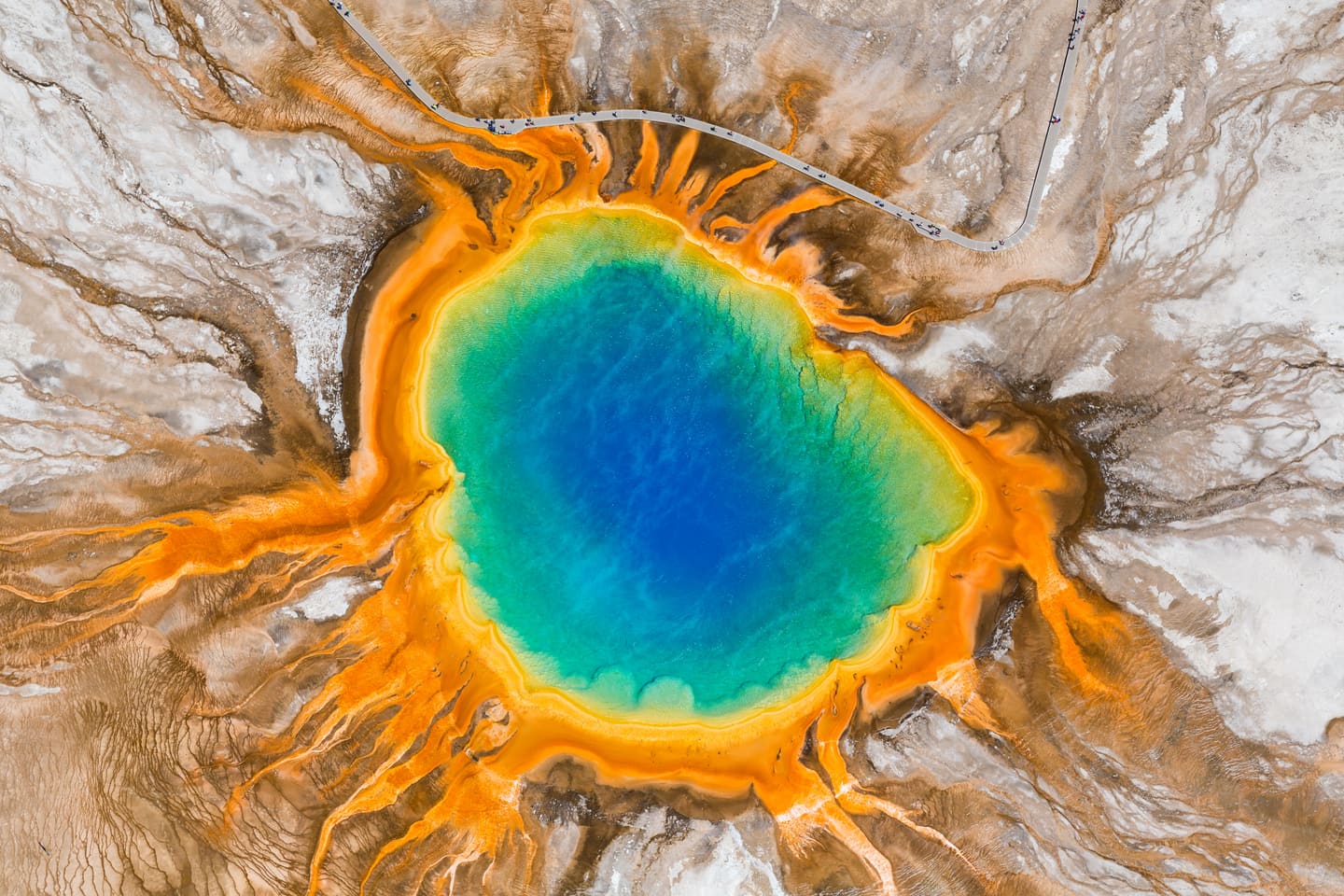
Yellowstone does not care that you have a toddler. The geysers erupt on their own schedule, the bison cross the road whenever they please, and the nearest bathroom is sometimes forty-five minutes away. None of that makes the park a bad place to bring kids, it just means the trip you plan has to match the kid you're bringing, not the other way around. The itinerary that delights a six-year-old will bore a teenager and flatten a toddler by 10 AM.
Watch enough families come through the boardwalks and a pattern shows up. The trips that go well are the ones where the adults quietly rebuilt the day around naps, or a badge ceremony, or how long a teenager will tolerate a single hike, instead of around the "must-see" list from a guidebook. The ones that fall apart usually tried to do too much. This guide is broken out by age, with the specifics that actually matter: stroller wheels, leash etiquette, which trails to skip, and what to do when a Junior Ranger booklet stops being cool.
At a Glance
Toddlers
The biggest mistake with a toddler in Yellowstone is treating the day like it belongs to the adults. A toddler day should have no more than two or three major stops. Old Faithful in the morning and Grand Prismatic in the afternoon is a full, good day. Try to also squeeze in Mammoth and Lamar Valley and you end up with a screaming car seat at 4 PM and a wrecked dinner.
Build the day around the nap. If your toddler reliably goes down between 12:30 and 2:30, turn that window into a driving block between destinations instead of dead time to fight against. The car nap often works better here than at home; the roads are slow and winding, and that tends to put kids under faster than highway driving does.
Strollers: bring an all-terrain stroller with real wheels, not an umbrella stroller. The Upper Geyser Basin around Old Faithful is the best of the bunch, a wide, flat, paved path runs from the visitor center all the way out to Morning Glory Pool, and you can stroller the whole thing. The lower loop at Mud Volcano is flat, though the full loop climbs a set of stairs you'll have to skip with a stroller. Be more careful about Mammoth Hot Springs: the upper terrace boardwalks are doable in spots but have stair sections, and the climb between the lower and upper terraces is hundreds of stairs, not a stroller route at all. Parts of Norris Geyser Basin, especially the Back Basin loop, have steep grades and uneven slats that are rough going on anything but all-terrain wheels. If you only bring one stroller, all-terrain is the one. The same stops tend to work for anyone in your group who can't manage long walks, our guide to seeing Yellowstone without hiking covers the overlap between stroller-friendly boardwalks and low-mobility routes.
Leashes near thermal areas: a wrist or backpack leash isn't overprotective here, it's the right gear. Boardwalks run directly alongside boiling pools and thin-crust ground, and the parking lots double as through-traffic for RVs that can't always see a toddler at knee height. A leash lets you carry a diaper bag, help an older sibling, and still hold onto a fast, unpredictable two-year-old without clamping their wrist the whole time. You'll see plenty of families using them out here, and the boardwalks are exactly where they earn their keep.
Car seats: if you're flying in, most rental counters in Bozeman or West Yellowstone offer car seats, but availability and quality vary a lot by season. Bringing your own is usually worth the hassle of checking it at the gate, especially if you have a specific convertible seat your toddler is used to.
What to skip: the Grand Canyon of the Yellowstone's South Rim trail, with its unfenced drop-offs and narrow footing near Artist Point, is not a toddler stop, view it from the main overlooks only and keep little hands held. Skip anything billed as a "moderate" hike with real mileage; toddlers do fine on flat, paved, half-mile loops and poorly on anything that requires sustained walking. And don't plan a toddler day around wildlife-watching in Lamar Valley before sunrise, the early wake-up works against the nap schedule you're trying to protect.
Preschoolers
Four and five is when Yellowstone starts to click in a way kids will actually remember. The best move at this age is to pick up a Junior Ranger booklet at any visitor center on your first day. It runs about $3 (check the visitor center for current pricing), and a four-to-seven-year-old works through a set of age-appropriate activities over the course of the visit, drawing, simple questions, a scavenger hunt for specific animals and features. When the booklet is done, a ranger reviews it, swears the kid in with a short oath, and hands over a Junior Ranger badge. It is one of the best pacing tools in the park: it gives a four-year-old a reason to pay attention at every stop instead of just enduring the drive between them.
Lean into short walks kids can do under their own power. The loop around Storm Point on the lake's north shore and the out-and-back to Wraith Falls near Mammoth are both manageable for a five-year-old with a few rest stops, and the sense of having "done a real hike" matters to kids this age. (The popular Mystic Falls hike runs from Biscuit Basin, which has been closed since a 2024 hydrothermal explosion, so check whether it has reopened before you count on it.) Boardwalk loops at any of the geyser basins also work well since they're flat and the next interesting thing is never more than a few minutes away.
Make wildlife-watching the headline, not a bonus. A slow drive through Lamar Valley with binoculars passed around the back seat tends to hold a preschooler's attention far longer than another thermal feature will, bison are close, large, and endlessly fascinating at this age, and "spot the bison" is a game that plays itself. If you have flexibility on dates, visiting during a quieter stretch makes wildlife-watching with young kids much less stressful; see our breakdown of crowds and timing in late August if you're choosing between travel windows.
On bear safety, give kids a simple, calm rule rather than a scary lecture. The park's own guidance for trails is the easy version to pass along: carry bear spray where you can reach it fast, and make noise as you walk so bears know you're coming, a steady "Hey bear!" every so often does the job. Framed that way, "we make noise so the bears hear us first" lands better with a five-year-old than a list of statistics. Letting a kid help check that the bear spray is within reach before a hike turns a safety habit into something they feel part of instead of frightened by.
Planning a Yellowstone trip with kids?
Sign up for early access and we'll send you age-aware itinerary tools and trip guides as the app comes together.
Grade-schoolers
Six to eight is where you can start handing kids longer, easy-to-moderate hikes, generally in the one-to-three-mile range with some real elevation change. Trails like the boardwalk and dirt-path combination around the Upper Geyser Basin, or the short climb to an overlook, are well within range, and kids this age often have more stamina than the adults give them credit for, especially with a snack break built in halfway.
Yellowstone tiers the Junior Ranger program by age, so a kid in this band works toward a different patch than the preschool crowd, and there's also a separate Young Scientist booklet for older kids who want something more involved. Specifics shift from year to year, so ask at the visitor center which booklet fits your kid's age rather than assuming the same one from preschool still applies. Either way, the swearing-in works as a pacing anchor for the day.
This is also the age where geyser-watching turns fun instead of being a long wait. Make a game of it. Have them predict the eruption timing, pick which geyser goes off first, watch for the rumbling and steam-pulse that warns a smaller geyser is about to go. The patience it takes to sit through Old Faithful or one of the other predictable geysers along the Upper Geyser Basin boardwalk lands far better with a small bet attached to it.
Biking options inside the park are limited, most roads don't have dedicated bike lanes and aren't safe for kids to ride alongside traffic, but a few paved, car-free paths do exist near developed areas; check current conditions and rules at a visitor center if biking is a priority, since access changes by area and season.
Don't skip the Old Faithful Inn lobby as its own activity. Walking through the soaring log-and-stone atrium, looking up at the crow's nest balcony, and finding the old popcorn popper clock are free, take fifteen minutes, and reliably impress kids this age, it feels like exploring a fort, which is exactly the energy a seven-year-old brings to it.
Teens
Most teenagers have aged out of the Junior Ranger booklet, and pushing it on them lands as babyish. Aim them instead at the parts of Yellowstone that read as impressive to a teenager: the scale of the place, the science under it, and the photography.
Teens can usually handle more ambitious hikes. The climb up Mount Washburn, with sweeping views of the Absaroka Range and a real shot at seeing bighorn sheep near the summit, is a good fit for a fit teenager, as is biking the flat, closed-to-cars road out to Lone Star Geyser, a quieter, less crowded geyser that erupts roughly every few hours and feels like a reward for the effort to get there.
Use wildlife photography as a hook. A decent zoom lens, or even a phone with a clip-on lens, turns a wildlife stop in Lamar Valley or Hayden Valley from "more bison" into a project, and gives a teen a reason to engage on their own terms instead of just trailing the itinerary.
On the educational side, this is the age to bring up the supervolcano story directly: Yellowstone sits on top of one of the largest volcanic systems on Earth, and the geysers, hot springs, and mud pots they're walking past are direct evidence of that system venting heat. Ranger talks on geology, wolves, and the night sky run throughout the season, with schedules posted daily at each visitor center. A well-timed evening talk or stargazing program often lands better with a teenager than anything else in the park. It treats them like someone capable of finding the subject interesting, which they usually are.
Give teens more rope on the boardwalks, they can walk a few steps ahead, take their photos, set their own pace, but the thermal safety rules don't loosen with age. Staying on the boardwalk and away from the edge of pools applies exactly as much to a sixteen-year-old as it does to a six-year-old; the ground doesn't know how old you are.
Practical gear for traveling with kids
All-terrain stroller, not umbrella
Most boardwalks are wide and flat, but a few sections, especially at Norris, have grades and rough wooden slats that an umbrella stroller's small wheels struggle with.
Wrist or backpack leashes
Near thermal boardwalks and parking lots, a child leash isn't excessive caution, it's appropriate gear given boiling water on one side and vehicle traffic on the other.
Layer for big swings
Mornings can sit in the 30s°F even in midsummer, with 70s°F by afternoon. Pack layers every kid can take off and stuff in a backpack themselves.
Snacks, water, and altitude
Services between stops are sparse, carry more water and snacks than feels necessary. Most of the park sits above 6,000 feet, so sun exposure and mild altitude effects hit kids faster than at home.
Putting it together
One thing holds across every age band: match the day to the kid in front of you, not the itinerary. Toddlers need naps and two or three stops. A preschooler runs on the next Junior Ranger activity and an easy walk. A grade-schooler can carry a real hike and a longer wait at a geyser. A teenager wants some independence, a good photo, and to be talked to like someone who can handle the supervolcano story.
None of that is about expecting less from the trip. It's about how good the trip gets when the pacing fits the people you brought. Plan around the kid you have this year. Next year they'll be a little older and you'll get to plan it all over again.
If you're ready to put the pacing above into an actual day-by-day plan, our 5-day Yellowstone itinerary is a good starting frame to adapt around your kids' ages.